
Embodied Perception
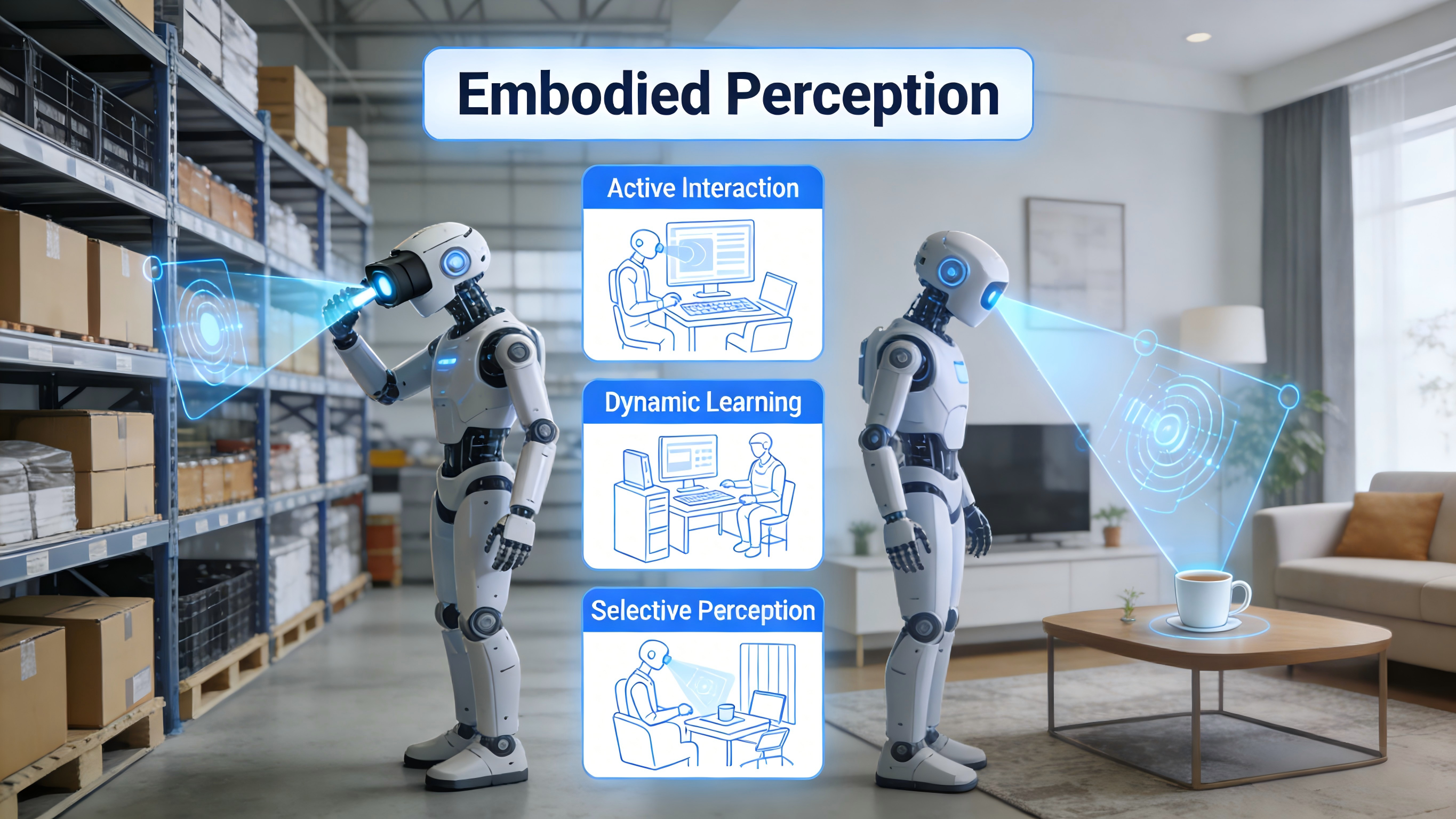
Embodied perception breaks the framework of traditional static image recognition by integrating the perceptual process into the interactive loop between the agent and the environment. This allows the agent to dynamically adjust its perception strategies according to task demands, shifting from 'passively receiving information' to 'actively acquiring information.' Our objective is to endow agents with generalized perception capabilities, making them adaptable to the diverse requirements of multi-task scenarios while balancing perception efficiency and robustness.
Active Visual Perception
Addressing the limitations of passive perception, such as restricted viewpoints and incomplete information, we research how to optimize information acquisition by actively controlling sensor movement. This aims to obtain more complete and clearer observations of targets, enhancing the robustness of recognition and interaction.
Our approach enables agents to dynamically adjust their perception strategies based on task requirements, moving beyond static observation to achieve more efficient and targeted information gathering.
Continual Perceptual Learning
We study how agents can effectively learn new knowledge and avoid 'catastrophic forgetting' of old knowledge when continuously encountering new categories and tasks, gradually building general perception and lifelong learning capabilities.
Our research focuses on developing algorithms that enable continuous adaptation to changing environments while maintaining performance on previously learned tasks.
Task-Driven Visual Perception
Addressing the need for efficient perception in complex embodied tasks, we investigate how to trim redundant information and achieve precise perception based on task objectives. By adaptively adjusting the computational resources and regions of interest of the perception system, we aim to balance perception speed and accuracy.
This approach enables agents to focus on task-relevant information while ignoring irrelevant details, improving overall system efficiency.